



Top 10 Types of Water Jet Cutting Machines?
Water jet cutting has moved from a specialist process into a serious production technology. It now serves aerospace, automotive, stone, glass, food, and metal fabrication. Grand View Research estimates that the global waterjet cutting machine market was worth approximately USD 1.3 billion in 2023. Its report also projects continued growth through 2030, supported by automated production and demand for precise, low-heat cutting.
Dr. Mohamed Hashish, a leading waterjet researcher and abrasive-waterjet pioneer, once described the technology as “the most versatile machine tool in the world.” That statement remains useful, but it needs context. Versatility does not guarantee the lowest cost, fastest cycle, or cleanest edge. Material thickness, pump pressure, abrasive flow, nozzle wear, and operator skill can change the result dramatically.
This guide examines the top 10 types of water jet cutting machines, including pure-water, abrasive, three-axis, five-axis, robotic, and hybrid systems. Each machine has a different working profile. A pure-water system may slice soft rubber cleanly, while an abrasive model can cut steel, granite, or composite panels. The difference is visible on the shop floor: one nozzle leaves a smooth, narrow stream, while another produces abrasive grit and requires careful maintenance. Industry reports provide useful market direction, but real purchasing decisions still depend on test cuts, operating costs, service support, and actual production demands. No ranking is perfect. A machine that suits an aerospace supplier may be excessive for a small stone workshop.
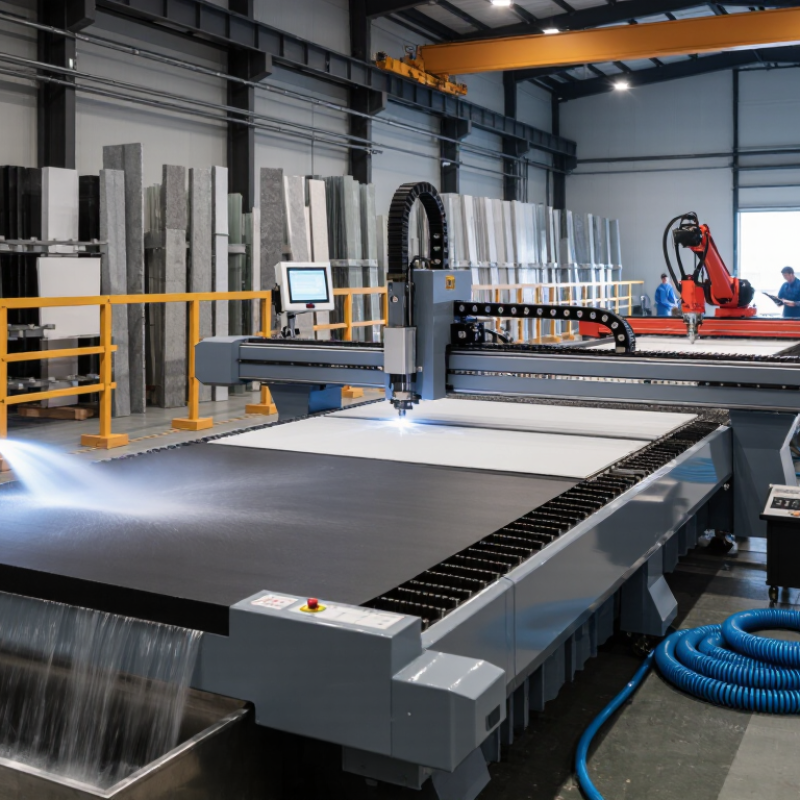
Water Jet Cutting Machine Classification and Core Operating Principles
Top 10 Types of Water Jet Cutting Machines
Water jet machines are classified by cutting medium, motion system, frame design, and application. The ten common types include pure-water, abrasive, three-axis, five-axis, gantry, cantilever, robotic-arm, tube-cutting, micro-waterjet, and multi-head machines. Each type solves a different production problem.
The core principle remains similar. A high-pressure pump forces water through a tiny orifice, creating a fast, concentrated stream. Pure-water systems cut soft materials such as rubber, foam, fabric, and food products. Abrasive systems add mineral particles to cut steel, stone, glass, and composites. Three-axis machines produce flat profiles, while five-axis systems adjust the cutting head for bevels and three-dimensional surfaces. Gantry frames suit large sheets. Cantilever designs improve access around smaller work areas. Robotic and tube-cutting systems handle curved or irregular parts. Micro-waterjets target delicate components with narrow kerfs. Multi-head machines increase output, but setup becomes less forgiving.
Tips: Check pump pressure, orifice wear, abrasive flow, and nozzle standoff before cutting. Water quality matters. Small errors can create taper, rough edges, or dimensional drift. In workshop use, a clean sample cut is more useful than a specification sheet. However, classification can be misleading. A five-axis machine is not automatically better; its value depends on material, tolerance, geometry, and operator skill. Even experienced users sometimes overlook abrasive moisture or delayed nozzle replacement.
Top 10 Types of Water Jet Cutting Machines? - Water Jet Cutting Machine Classification and Core Operating Principles
| No. | Machine Type | Cutting Medium | Motion or Axis Configuration | Core Operating Principle | Typical Materials | Main Advantages |
|---|---|---|---|---|---|---|
| 1 | Pure Waterjet Cutting Machine | High-pressure water only; no abrasive particles | Usually 2-axis to 3-axis | A high-pressure water stream passes through a small orifice and cuts mainly through erosion and shearing. The soft jet is suitable for materials that do not require abrasive particles. | Rubber, foam, felt, textiles, insulation, food products, paper, and thin plastics | No abrasive handling, low cutting force, minimal heat-affected zone, and a clean process for suitable soft materials |
| 2 | Abrasive Waterjet Cutting Machine | High-pressure water mixed with garnet or another approved abrasive | Usually 2-axis to 5-axis | Water accelerates abrasive grains through a mixing tube. The abrasive stream removes material by micro-cutting, erosion, and impact rather than by melting. | Steel, stainless steel, aluminum, titanium, stone, glass, ceramics, composites, and multilayer materials | Cold cutting, broad material compatibility, no thermal distortion, and the ability to cut reflective or heat-sensitive materials |
| 3 | 3-Axis Waterjet Cutting Machine | Pure water or abrasive waterjet | Linear X, Y, and Z movement; fixed vertical cutting head | The cutting head moves along a flat Cartesian coordinate system. The jet remains approximately perpendicular to the work surface, making it suitable for flat profiles. | Sheet metal, plate, stone, glass, plastics, rubber, and composites | Simple programming, reliable operation, lower equipment complexity, and cost-effective 2D profile cutting |
| 4 | 4-Axis Waterjet Cutting Machine | Usually abrasive waterjet | Three linear axes plus one rotary or controlled tilting axis | In addition to X, Y, and Z travel, one rotary degree of freedom allows the jet direction or workpiece orientation to change for selected angled or indexed cuts. | Metal plate, stone, glass, and fabricated components requiring limited angular features | More flexibility than a 3-axis system while remaining less complex than a full multi-axis machine |
| 5 | 5-Axis Waterjet Cutting Machine | Usually abrasive waterjet | Three linear axes plus two rotary or tilting axes | The cutting head continuously controls jet angle in multiple directions. Software compensates for jet lag, taper, and angular geometry to produce beveled or three-dimensional cuts. | Aerospace alloys, automotive parts, stone, glass, composites, and complex metal components | 3D cutting capability, reduced secondary machining, precise bevels, and improved access to complex contours |
| 6 | Micro Waterjet Cutting Machine | Fine waterjet, commonly with a small-diameter abrasive or pure-water stream | Typically 3-axis to 5-axis | A reduced jet diameter and carefully controlled abrasive flow create a narrow kerf for small features and detailed profiles. The process follows the same erosion-based principle as conventional waterjet cutting. | Thin metals, medical components, electronics, ceramics, glass, and miniature precision parts | Fine kerf, small minimum feature sizes, low cutting forces, and limited thermal damage |
| 7 | Robotic Waterjet Cutting System | Pure water or abrasive waterjet | Multi-axis industrial robot, commonly with six or more controlled axes | A robot positions and orients the cutting head around contoured or irregular workpieces. The controller coordinates robot motion, cutting speed, and jet angle. | Automotive components, molded composites, interior panels, foam, plastics, and three-dimensional parts | Flexible reach, reduced need for dedicated fixtures, suitability for 3D surfaces, and convenient integration with automated production cells |
| 8 | Tube and Pipe Waterjet Cutting Machine | Usually abrasive waterjet | Linear axes combined with rotary tube or pipe positioning | The workpiece rotates while the cutting head moves along its length, or the head follows a coordinated path to create holes, slots, notches, and end preparations on tubular parts. | Steel pipe, stainless tubing, aluminum profiles, structural tube, and fabricated hollow sections | Multi-sided access, accurate hole and notch production, reduced setup time, and less need for separate drilling or milling operations |
| 9 | Stack-Cutting Waterjet Machine | Pure water or abrasive waterjet, depending on the material | Usually 3-axis or 5-axis; workpieces are arranged in aligned layers | Several thin sheets or laminates are clamped and cut simultaneously. The process relies on sufficient jet energy, stable fixturing, and suitable compensation for taper and layer movement. | Gaskets, thin sheet metal, composites, textiles, leather, plastics, and laminated materials | Higher throughput, consistent repeated parts, and lower handling time when the stack height and material combination are properly controlled |
| 10 | Hybrid Waterjet Cutting Machine | Waterjet combined with another process, such as milling, drilling, or laser cutting | Shared CNC platform with multiple tool heads or integrated process stations | The waterjet performs cold profile cutting while a secondary process handles drilling, tapping, pocketing, edge finishing, or other operations. CNC coordination maintains part registration between processes. | Metal plate, aerospace composites, stone, glass, and parts requiring several machining operations | Fewer setups, improved process integration, reduced work-in-process handling, and the ability to combine complementary manufacturing methods |
Related Posts
-

2025 Top 10 Water Jet Cutting Machines for Precision and Efficiency
-
2026 Best Water Jet Cutting Machine Options for Precision Fabrication?
-
Essential Tips for Choosing a Water Jet Cutting Machine?
-
Why is Sheet Metal Water Jet Cutting the Preferred Method for Precision Fabrication?
-
Top 10 Benefits of Water Jet Cutting Machines for Buyers
-
2026 Top Trends in Sheet Metal Water Jet Cutting Technology?